

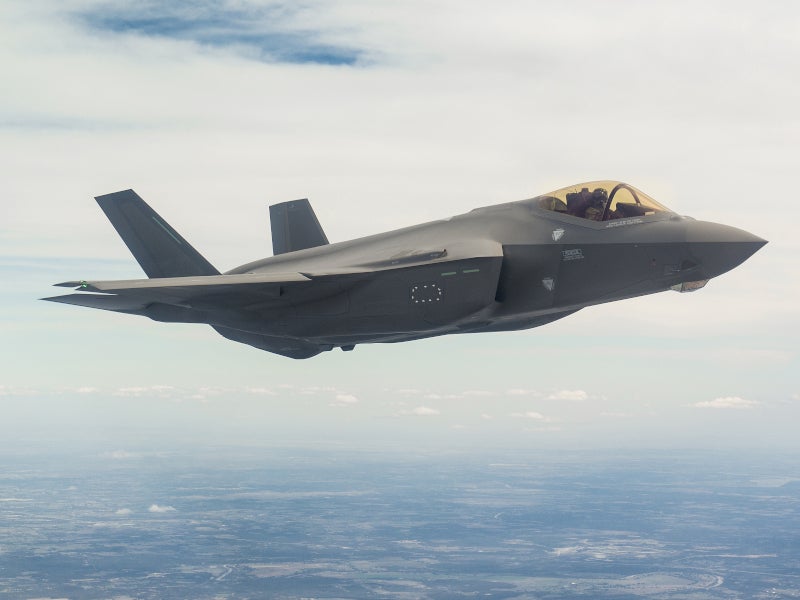
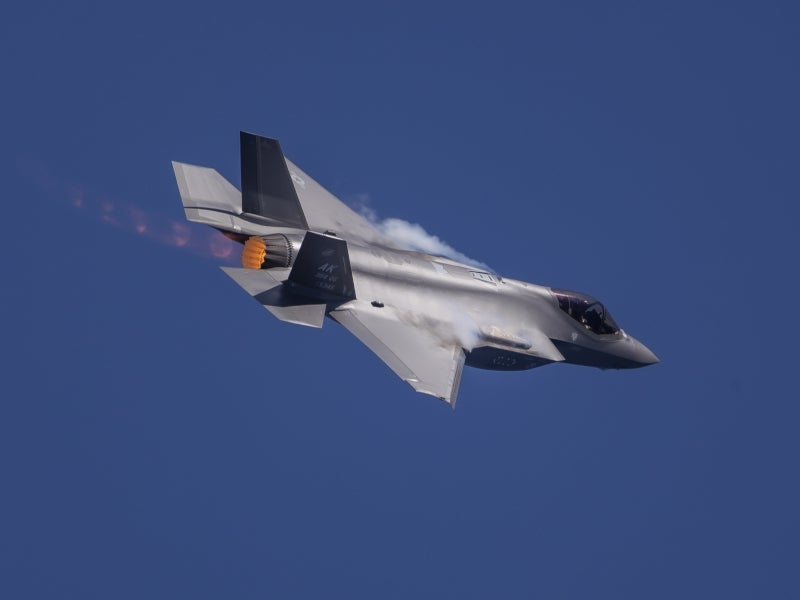
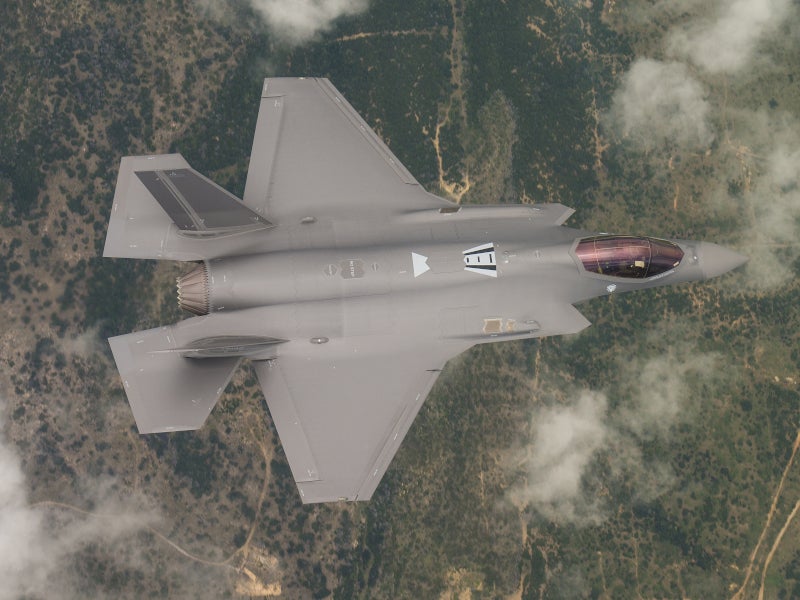
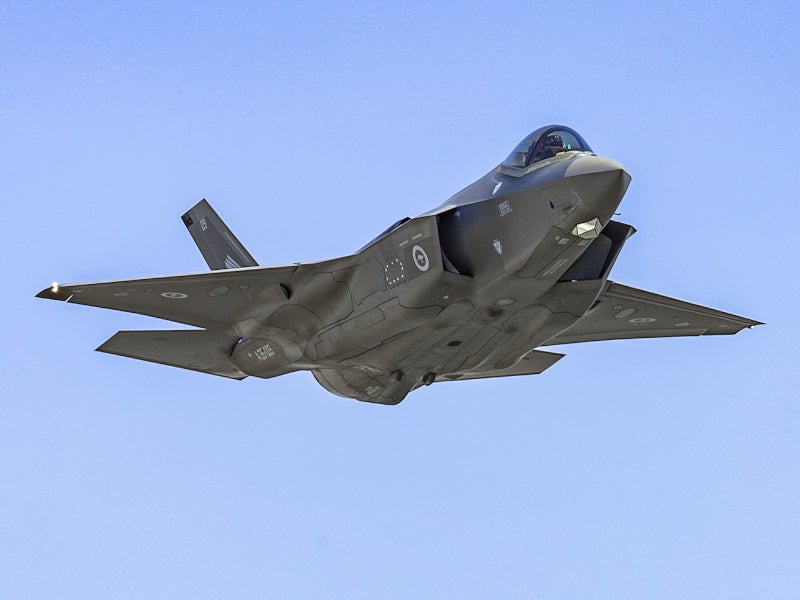
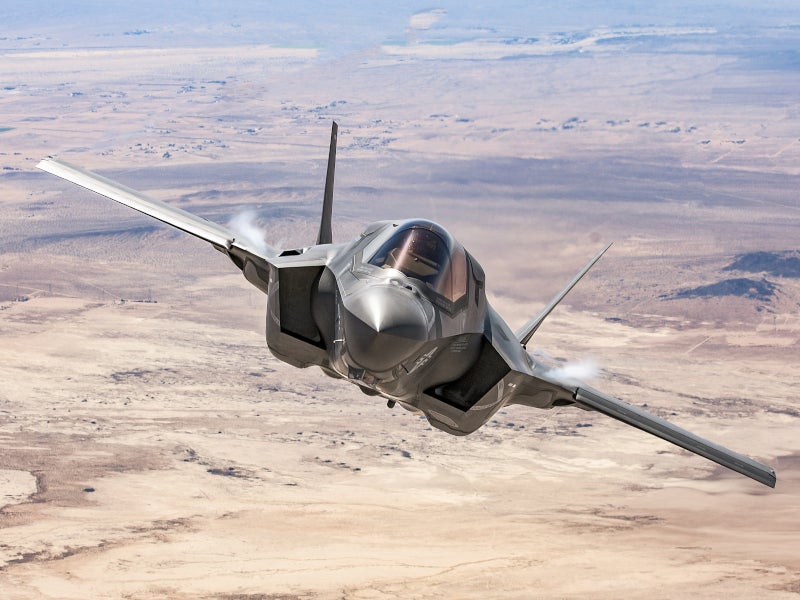
The F-35 Lightning II Joint Strike Fighter (JSF) is a strike fighter aircraft capable of performing air-to-ground and air-to-air combat operations.
Developed by Lockheed Martin, the aircraft is in service with the US Air Force (USAF), US Navy, United States Marine Corps (USMC), programme partners from the North Atlantic Treaty Organization and US allies.
Recommended White Papers

Recommended Buyers Guides

The single-seat fighter was designated the F-35 Lightning II in July 2006. The JSF is available in three variants: F-35A, a conventional take-off and landing aircraft (CTOL); F-35B, a short take-off and vertical landing (STOVL) aircraft; and F-35C, a carrier variant.
More than 1,300 F-35 aircraft have been delivered as of March 2026.
US deploys F-35 aircraft in Iran-Middle East crisis
The F-35 aircraft is currently supporting the US in the ongoing US-Iran war.
In February 2026, the US launched Operation Epic Fury, along with Israel, targeting Iran’s military infrastructure.
F-35C Lightning II aircraft from Marine Fighter Attack Squadron 314, embarked on USS Abraham Lincoln (CVN 72), were positioned ready for flying operations in support of Operation Epic Fury in March 2026.
US Central Command highlighted that the aircraft were performing combat operations over the skies of Iran.
Iran claimed to have destroyed an F-35 aircraft, according to media reports, although these claims have not been verified.
Lightning II JSF development
The concept demonstration phase of the F-35 Lightning II JSF programme began in November 1996 with contracts awarded to two consortia, led by Boeing Aerospace and Lockheed Martin. The contracts involved the building of demonstrator aircraft for three different configurations of JSF, with one of the two consortia selected for the development and manufacture of all three variants.
In January 2001, the UK Ministry of Defence signed a memorandum of understanding to cooperate in the system development and demonstration (SDD) phase of JSF and, in September 2002, selected the STOVL variant to fulfil the future joint combat aircraft requirement.
Other SDD partner nations were Australia, Canada, Denmark, Italy, the Netherlands, Norway, Singapore and Turkey. Countries signing foreign military sales (FMS) agreements were Belgium, the Czech Republic, Finland, Germany, Greece, Israel, Japan, Poland, the Republic of Korea, Romania and Switzerland.
In October 2001, an international team led by Lockheed Martin was awarded the contract to build the JSF. Lockheed Martin produced the winning airframe approach and continues to act as the lead contractor, working with key suppliers to deliver critical onboard systems.
The Lockheed Martin JSF team includes Northrop Grumman, BAE Systems, Pratt and Whitney and Rolls-Royce. Terma (Denmark) and Turkish Aerospace Industries (TAI) (Turkey) supply centre fuselage sub-assemblies.
The JSF passed preliminary design review in April 2003. Critical design reviews were completed for the F-35A in February 2006, F-35B in October 2006 and F-35C in June 2007. The CTOL F-35A first flew in December 2006.
Manufacturing began in 2006, with final assembly at Lockheed Martin’s Fort Worth plant, Texas.
Low-rate initial production (LRIP) for the F-35A/B was approved in April 2007, while an LRIP 2 contract for six CTOL aircraft was placed in July 2007.
The STOVL F-35B was rolled out in December 2007 and made its first flight, a conventional take-off and landing, in June 2008. STOVL flights began in early 2009.
An LRIP contract for six F-35B STOVL aircraft was placed in July 2008. The F-35C took off on its first flight in November 2011.
The development of the centre fuselage for the first international F-35 JSF began in October 2009. It was developed by Northrop Grumman, principally for the UK. The centre fuselage, including composite air inlet ducts, were supplied by TAI.
The F-35B STOVL variant, designated BK-1, completed its assembly in November 2011. The variant was developed as part of the LRIP 3 and made its first flight in April 2012.
F-35 JSF design and features
The F-35A aircraft has a length of 51.4ft (15.7m), a height of 14.4ft and a wingspan of 35ft. It has a wing area of 460ft² and an empty weight of 29,300lb.
The F-35B STOVL aircraft measures 51.2ft in length, 14.3ft in height and has a wingspan of 35ft. The wing area is 460ft² and the empty weight is 32,300lb.
The F-35C has a length of 51.5ft, a height of 14.7ft and a wingspan of 43ft. It has a wing area of 668ft² and an empty weight of 34,800lb.
F-35 Block 4 modernisation programme details
The F-35 Block 4 modernisation is designed to ensure that the aircraft remains capable of countering evolving threat environments. The programme will deliver more than 70 upgrades to all the variants of the aircraft.
F-35s configured to the Block 4 standard will be able to carry a larger missile load, field more sophisticated non-kinetic electronic warfare options, and increase overall lethality through improved sensors and stronger target identification.
Technology Refresh-3 (TR-3) underpins the delivery of the F-35’s Block 4 upgrade package, providing the computing headroom needed to host more sophisticated software and integrate the latest front-line combat functions on the F-35.
The first TR-3 configured aircraft were delivered in July 2024 by Lockheed Martin. By the end of September 2025, 159 F-35s in the TR-3 configuration were delivered.
Cockpit and radar
L3Harris manufactures the F-35’s panoramic cockpit display electronic units and display units as part of the Block 4 modernisation, giving pilots a comprehensive, all-around view of the operational environment.
The aircraft features a state-of-the-art helmet-mounted display, which projects essential mission data, such as situational awareness and targeting cues, directly onto the pilot’s visor.
The F-35 is equipped with an advanced electronically scanned array AN/APG-81 multi-function radar, which combines an integrated radio frequency subsystem with a multifunction array.
Weapons and armaments
Weapons are carried in two parallel bays located in front of the landing gear. Each weapons bay is fitted with two hardpoints for carrying a range of bombs and missiles.
Weapons to be cleared for internal carriage include: Advanced Anti-Radiation Guided Missile – Extended Range, Stand-in Attack Weapon, 2,000lb GBU-31 Joint Direct Attack Munition guided bombs, AIM-120C AMRAAM air-to-air missile and 25mm GAU-22/A gun system.
Fire control and targeting technology
Lockheed Martin Missile & Fire Control and Northrop Grumman Electronic Sensors and Systems are jointly responsible for the JSF electro-optical system. The Lockheed Martin electro-optical targeting system (EOTS) provides long-range detection and precision targeting, along with the Northrop Grumman distributed aperture system (DAS) thermal imaging system.
EOTS is based on the Sniper XL pod developed for the F-16, which incorporates a mid-wave third-generation forward-looking infrared, dual-mode laser, CCD TV, laser tracker and laser marker. BAE Systems provides the laser systems.
DAS consists of multiple infrared cameras (supplied by Indigo Systems of Goleta, California) providing 360° coverage using advanced signal conditioning algorithms. As well as situational awareness, DAS provides navigation, missile warning and infrared search and track. EOTS is embedded under the aircraft’s nose, and DAS sensors are fitted at multiple locations on the aircraft.
Contractors involved
Systems and suppliers were provided by Honeywell, Goodrich and Parker Aerospace. Collins Aerospace and Elbit Systems formed a joint venture to advance helmet-mounted display systems for the F-35 programme.
The aircraft development included other suppliers such as ATK Composites, Vought Aircraft Industries, Smiths Aerospace, Moog and EDO Corporation.
In March 2020, Lynx Software Technologies and Core Avionics & Industrial were selected to support the development of the PCD-EU.
Pratt & Whitney won a contract to undertake an F135 upgrade study and operational assessment by the F-35 Joint Program Office (JPO) to identify propulsion system growth needs for Block 4.2 F-35 aircraft and above in October 2020.
In April 2023, BAE Systems was awarded a $491m contract to deliver Block 4 electronic warfare systems to the aircraft.
Kongsberg Defence & Aerospace entered into a deal worth Nkr2bn ($207.6m) with Lockheed Martin in March 2026 to supply components for the F-35 fighter jet. The company previously received a Nkr2bn contract in July 2019 to deliver rudders and landing gear components for lots 12–14 aircraft.
In same month, Pratt & Whitney was awarded a $3.8bn contract modification to manufacture lots 18–19 F135 engines. The company had previously secured a $2.8bn contract in August 2025 to manufacture engines for Lot 18. The contract modification increases the total value of the contract for lots 18–19 to $6.6bn.
Pratt & Whitney also received a $1.6bn contract in December 2025 for the sustainment of F135 engines. The sustainment activities will span maintenance, repair, replenishment of spare parts and engineering support.
Propulsion and performance of the JSF aircraft
All three variants are powered by the Pratt and Whitney low-bypass augmented turbofan F135 engine, a derivative of the F119 fitted on the F-22 Raptor, providing a maximum thrust of 43,000lb (191 kilonewtons).
Each engine is fitted with two BAE Systems full authority digital electronic control systems. Hamilton Sundstrand (now part of Collins Aerospace) provides the gearbox.
On the F-35B, the engine is coupled with a shaft-driven lift fan system for STOVL propulsion. The counter-rotating lift fan, developed by Rolls-Royce Defence, can generate more than 20,000lb of thrust. Doors installed above and below the vertical fan open as the fin spins up to provide vertical lift.
The main engine has a three-bearing swivelling exhaust nozzle. The nozzle, which is supplemented by two roll control ducts on the inboard section of the wing, together with the vertical lift fan provide the required STOVL capability.
The aircraft has a maximum speed of Mach 1.6 (~1,200mph), a range of more than 1,200 nautical miles and a ceiling above 50,000ft (15km).
Orders and deliveries
The USAF has ordered 1,763 F-35A aircraft, while the USMC has ordered 353 F-35B and 67 F-35C aircraft. The US Navy has ordered 273 F-35C aircraft.
The UK has placed orders for a total of 138 aircraft. The first aircraft was delivered in 2012. In June 2025, the UK Government announced its intention to acquire 12 new F-35A fighter jets.
The Netherlands has a total of 57 aircraft on order. The first F-35 aircraft achieved initial operating capability in January 2022.
Australia has 100 F35s on order, with the first aircraft delivered in 2014. The Republic of Korea has 60 F-35A aircraft on order and has received 40 aircraft.
In May 2008, Israel requested the sale of 25 F-35A aircraft with 50 options and ordered a further 20 F-35 aircraft in 2010. The first aircraft was delivered in June 2016.
Japan placed an order for 127 F-35 Aircraft, consisting of 105 F-35A models and up to 42 F-35B models, in 2011. The first aircraft was delivered in 2017.
Norway has placed orders for a total of 52 aircraft. Deliveries of all the aircraft were completed in 2025, with Norway becoming the first country to fulfil its Programme of Record.
Denmark placed an order for 27 F-35 aircraft in 2016 and received the first aircraft in 2021. Delivery of the remaining aircraft in this order is expected to conclude in 2026. In October 2025, Denmark announced its intention to acquire 16 additional aircraft.
The Italian Parliament approved the purchase of 131 F-35 aircraft. In 2025, Italy ordered 25 additional aircraft.
In January 2018, the Government of Belgium requested the sale of 34 F-35s. The first aircraft was delivered in 2023.
Poland has placed an order for 32 aircraft, while Switzerland plans to procure 30 aircraft.
Germany placed an order for 35 F-35s for €8.3bn ($8.33bn). Production of the first aircraft began in 2024.
Finland plans to procure 64 F-35s, with the delivery of the first aircraft scheduled for 2026.
Singapore has finalised the procurement of 30 F-35 aircraft. The first 20 aircraft are scheduled to be delivered by the end of 2026.
Greece placed an order for 20 F-35s, with options for up to 20 additional aircraft, while Romania’s government plans to acquire 32 F‑35 jets.
Canada plans to procure 88 F-35s for C$27.7bn ($20.6bn). The first aircraft is expected to be delivered in 2026, with initial operating capability targeted for 2029/30.
The Czech Republic placed an order for 24 F-35 aircraft to replace the Czech Air Force’s fleet of Gripens. The first aircraft is set to be delivered in 2031.
In October 2019, the US Department of Defense reached an agreement worth $34bn with Lockheed Martin for the purchase of 478 F-35 aircraft across Lots 12-14. The deal covers the delivery of aircraft to the US and its partner nations.
In December 2022, the F-35 JPO and Lockheed Martin concluded an agreement worth $30bn for up to 398 aircraft for the US, partner nations and FMS customers under Lots 15 and 16, with provision to extend into Lot 17.
Lockheed Martin and the F-35 JPO reached a $24bn agreement for Lots 18-19 in September 2025, covering the production and delivery of up to 296 F-35s.
